So yeah… I picked up DJing during the pandemic. Everyone came out of lockdown with a random new skill – mine just so happened to involve spinning tunes instead of baking banana bread.
I started on Traktor gear, then eventually levelled up to Pioneer. Right now I’m using the Pioneer XDJ-XZ, at the time it was the closest thing you could get to a full CDJ setup without dropping £7k on actual CDJs. Lovely bit of kit if I say so myself.
Prepping the Tunes – The Workflow
Before any track even touches my library, it goes through two bits of software:
1. Mixed In Key
This checks the musical key so I know exactly what blends harmonically. It’ll also append the “Energy” of the track to the comment tags within the track.
Producers don’t follow a “volume standard.” Some tunes scream, some whisper. Platinum Notes levels everything out so your mix doesn’t suddenly smack someone in the face with a +6dB surprise.
3. Comment tags
Once I hear the track, I’ll add some hash tags to the comments section so I know the make up of the track. Things like #MaleVocals, #Mellow, #Banger, #Piano – these are elements within the track so I can find similar or complimentary tracks, not just by the energy and key.
Once those 3 are done, into Rekordbox they go, and that’s where the fun starts: Cueing, Tagging, Colour coding… basically turning chaos into order.
Understanding a DnB Track
When I first started mixing, I cut my teeth on Drum and Bass. Over time I realised you can make your life so much easier if you understand the structure and set up your tracks properly.
Beats, Bars & Phrases
Electronic music typically runs on a 4/4 signature – four beats to the bar.
A bar = 4 beats.
A phrase = a group of bars.
Most DnB phrases are 16 bars, which is 64 beats. That’s usually where something changes – a build, a drop, a switch-up, whatever.
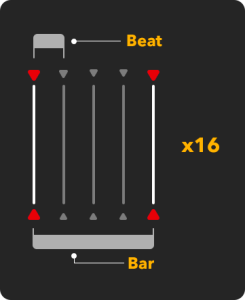
Beat, Bar & Phrase
The Usual Structure of a DnB Track
Most Drum and Bass tunes follow a pretty predictable shape:
- Intro
- Main Drop
- Breakdown
- Second Drop
- Outro

The make up of a DnB track.
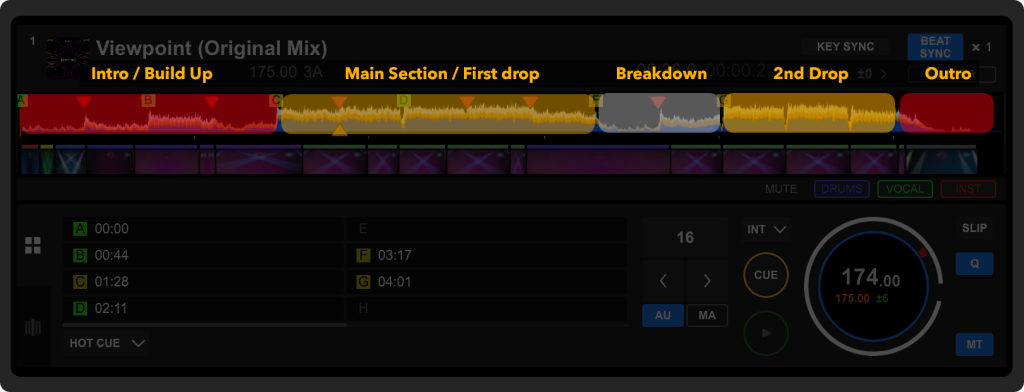
This consistency is gold for DJs because it makes “mix-in” and “mix-out” points much easier to plan.
But here’s the twist…
Not all intros or breakdowns are the same length.
Some intros are 64 beats, some 128, some 256 — but they’re almost always divisible by 64.
Once I clocked that, I started dropping cue points every 64 beats. It turned track prep into a cheat code.
Cue Points & Colour Coding – My System
Cue points alone weren’t enough. On gear like CDJ-2000s, the waveform isn’t detailed enough to reliably tell when breakdowns or drops are coming.
So I colour code everything. My system’s simple:
 Generic cue |
 Breakdowns and drops |
 Mix out cue |
 Memory Marker for extra detail |
This gives me a visual roadmap on the deck – especially useful when you’re mixing live and your brain is doing 700mph.
How I Actually Mix DnB
Once the tracks are analysed, corrected, cue’d, coloured, and ready… the main move is lining things up harmonically and structurally.
I’ll usually match:
– Breakdown of Track A
with
– Drop of Track B
That gives you that clean, energetic handover that sounds intentional rather than “oops.”

After that, you can get creative:
- Mixing in mid-breakdown
- Blending after the second drop
- Riding vocals between verses
- Double drops
- Fake outs
- Holding the tension before dropping the hammer
Once you get a feel for it, you start building little routines. Eventually you end up with something like this…